

Economic stagnation is harming our health

If the pre-financial crisis trend in living standards had been maintained, British households would today be £7,000 per person better off.
The UK would be significantly healthier than it is today if pre-crisis growth had persisted. I estimate that:
750,000 fewer working-age people would be in poor health
There would be 2,500 fewer deaths of despair (suicide, drugs and alcohol-related deaths) each year.
If the economy had maintained pre-financial crisis growth, there would be £80bn more funding per year available for the NHS, further strengthening health outcomes - equivalent to the salaries of over 2.5 million newly qualified nurses or the capital expenditure costs of building 63 new hospitals.
Britain’s weak growth record is usually discussed as an economic problem: lower wages, weaker tax revenues, squeezed public services and a smaller fiscal margin for government. But it is also a health problem.
Some recent number-crunching I have undertaken suggests that the UK is not just poorer than it might have been had governments delivered a more pro-growth agenda. It is also sicker than it might have been. Here is what the numbers show.
First, the economic backdrop: a terrible decade for prosperity
Since the financial crisis, the country has experienced an extraordinary slowdown in living standards. After adjusting for inflation, per capita household incomes grew at an annual rate of just 0.8% between 2010 and 2025, a third of the growth rate of of 2.4% seen pre-financial crisis (1995 to 2007).
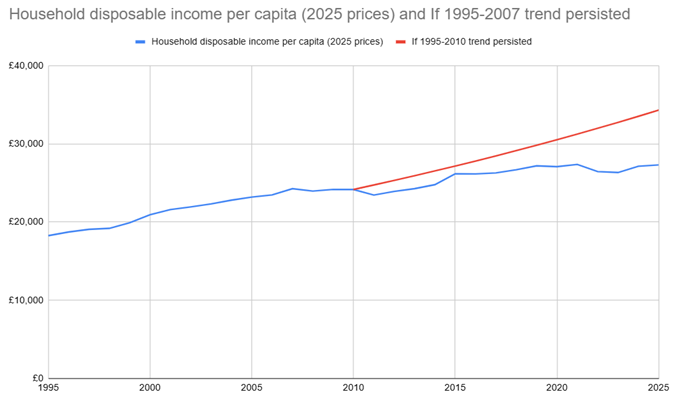
If the pre-financial crisis trend in living standards had been maintained, British households would today be £7,000 per person better off.
The health consequences of weak economic growth
There is significant evidence that income and job insecurity worsen mental and physical health. But the link between income and health is not just about poverty: research by the Health Foundation shows that even among higher-earning households increases in income are associated with better health outcomes. This suggests that a more prosperous economy has the potential to increase health outcomes across all parts of society.
Had economic growth and in turn living standards maintained the pre-financial crisis trend:
750,000 fewer working-age adults would be in poor health
My economic modelling suggests that there would be about 750,000 fewer working-age people with bad health had incomes across the UK mirrored pre-financial crisis growth rates. This amounts to a 19% reduction on what the UK is actually experiencing at present (close to four million working-age adults with “bad” or “very bad” self-reported health).
The analysis drew on DWP data on household income growth by quintile over time, comparing the pre- and post-financial crisis trajectories for these groups. A “counterfactual UK” was then constructed where income growth had not lost momentum since 2010 - with health outcomes then modelled for these new income levels.
There would be 2,500 fewer “deaths of despair” per year
My modelling has also identified a statistically significant link between average wages in a local authority area and the rate of “deaths of despair” - a term used to describe deaths from suicide, alcohol and drugs. Other important determinants of higher rates of deaths of despair were found to be the number of individuals living alone, the unemployment rate, the share of the population that is white British and whether the local authority is in the North of England - a part of the country where many areas have faced long-term economic challenges.
I modelled a “counterfactual England & Wales” in which average wage growth across local authorities had matched pre-financial crisis norms. Under this counterfactual, the modelling suggests 2,500 (13%) fewer deaths from suicide, drugs and alcohol would take place each year.
Not just worse health, but less money to finance the health service
Weak growth has not only made people poorer; it has made the NHS poorer too - further worsening health outcomes. If the economy had grown in line with pre-financial crisis levels, central government receipts would be £290bn per year higher.
If the amount of government spending dedicated to healthcare spending remained where it is today, this would entail £80bn more per year for the NHS - equivalent to the salaries of over 2.5 million newly qualified nurses or the capital expenditure costs of building 63 new hospitals. In percentage terms, this represents a circa 24% increase in UK healthcare spending.
The vicious cycle: poor growth causes poor health, and poor health causes poor growth
As things stand, the UK is stuck in a negative cycle in which a weak economy leads to worse health outcomes, and worse health further undermines growth through increased economic inactivity and a less productive workforce.
It also places pressure on the public finances through multiple channels: lower tax receipts, more welfare recipients and increased demands on the NHS.
There is not a choice between a growth agenda and a health agenda. The UK cannot have a serious growth strategy without a health strategy, and it cannot have a serious health strategy without thinking about how to boost economic growth and, in turn, household incomes.


Comments